Showing posts with label children. Show all posts

Thursday, September 13, 2012

ADHD and Emotional Maturity


From Not Wrong, Just Different

Emotional development in children with ADHD is 30% slower than their non-ADD peers. This means that a child that is 10 years old will have the emotional development of a 7 year old, a 20 year old will have the emotional maturity of a 14 year old.

What does this mean for our relationships with those with ADHD?

Manage your expectations.
When setting discipline and punishment, do the math in your head first.  If your child is 12 and gets into trouble, count down the 30% and ask if that was normal behavior for an 8 year old.  Then react.
When setting your boundaries, manage to the 30%.  The rest of the kids in that age group may have privileges that your child isn’t ready for.  Be careful not to “baby” or “enable”.  This also means you will need to be more purposeful and specific to teach your child how to make good choices. Do this with love, not shame or comparison.  Live by the motto, “Meet them where they are and love them forward.”

The Contradiction:
Those with ADHD are often intellectually advanced with an amazing vocabulary. When their words and intelligence are advanced and their emotional maturity behind, it is confusing.  My son was in fourth grade when I learned this statistic.  It put so many things in perspective for me.  My frustration eased and I learned to manage each of them separately, the intellect and the emotions.  I had a conversation with his teacher and she found it dead on from her experience and helpful for her teaching too.


Thursday, March 15, 2012

ADHD and immaturity

Re-posting from the io9 article Are kids being diagnosed with ADHD just for being young?:
While ADHD is a very real disorder, many argue that it's diagnosed far more often than it should be. But why are kids being misdiagnosed with this disorder? According to a new Canadian study, it might just be because they're younger than their peers.In British Columbia, the age cutoff date for entering each grade is December 31st of whatever year — making those born in December the youngest in the class, and those born in January the eldest. Examining a cohort of more than 900,000 students, the researchers found a significant correlation between birth month and ADHD diagnosis. In fact, children born in December were 39% more likely to be diagnosed and 48% more likely to be treated with medication for ADHD than those born in January. The situation was even worse for young girls, where the December-born were 70% more likely to be diagnosed.
This research paints a picture of children who are immature due to age differences being treated as though they have a lifelong disorder.
"The relative age of children is influencing whether they are diagnosed and treated for ADHD," said lead author Richard Morrow in a statement. "Our study suggests younger, less mature children are inappropriately being labelled and treated. It is important not to expose children to potential harms from unnecessary diagnosis and use of medications." 
This has an obvious two-fold negative effect. The misdiagnosed children are put on medications they don't need, and the people who argue that ADHD doesn't exist get more ammunition. The researchers argue that more stringent analysis before diagnosis could help, specifically taking into account the child's relative age to their peers, and their behavior outside of school.

Monday, March 12, 2012

Play with your kids

From The Age newspaper

A new study that found almost 50 per cent of kids don't play every day has prompted an expert's warning about a generation of depressed and anxious youngsters.

The study, hailed as the first of its kind in Australia, carried out a total of 1397 interviews, including 344 with children aged between eight to 12.

About 40 per cent of them said they don't have anyone to play with while 55 per cent say they'd like to spend more time playing with their parents.
and
"This finding highlights a concerning yet common misperception that many parents share - they dont think that kids need to play regularly after the age of eight," she said.

"In reality, active play is extremely important for eight to 12-year-old children as it is a critical development stage."

Dr Barrett also warned that parents and children could miss out on the opportunity for important bonding time that happens during play.

"Interestingly, kids are actually calling for parents to join them at playtime," she said.

Wednesday, March 7, 2012

Friday, December 23, 2011

Free range kids (again)

More on Free range kids from Boston Magazine
IN THE ARLINGTON middle school cafeteria, Michael Thompson asks if anyone wants to share their sweetest memory from childhood. I raise my hand and tell the group how, when I was eight, my friends and I discovered a frozen pond way back in the woods. We raced home to get our ice skates and laced them up in the hollowed-out trunk of a towering tree. And then, accompanied only by the sounds of our voices, laughter, and the scratching of our blades, we skimmed the ice, unsupervised, for hours.

“Why,” Thompson asks me in front of all the parents, “is that memory so sweet?”

Without thinking, I say, “Because my parents didn’t know where I was.”

“Your parents didn’t know where you were. So that experience was wholly your own,” he says. Then: “Would you let your own children do that?”

Sunday, December 18, 2011

Marital bliss

Interesting article from the Sydney Morning Herald

"Whether measuring life satisfaction, marital satisfaction, mental health or happiness levels, parents often rate worse than non-parents. New research shows it does not have to be that way. The secret to parental happiness lies in a spirit of generosity towards one's partner, according to a study from the National Marriage Project at the University of Virginia, called When Baby Makes Three.
How often partners express affection for each other, their willingness to forgive each other's faults, the small acts of service, such as making a cup of tea or giving a back rub, appear crucial in sustaining a couple through the shoals of parenthood."

And

"Other elements, such as good sex, shared housework and religious faith and commitment, also seemed to boost chances of successfully combining marriage and parenting, according to the report. But making the effort to be affectionate and generous to each other was a crucial ingredient."

Tuesday, October 25, 2011

Aquariums

My last two fish died a while ago. The cover had come off the water inlet and the stupid fish must have gone up the intake tube to investigate - but got mulched. I still feel really bad about it. Then I saw this

Source

Friday, September 23, 2011

Single sex schools no better than co-ed

From io9
Science has just published an article stating that claims of the benefit of single sex schooling lack any empirical evidence. The authors go so far as to call these claims pseudoscience.
The researchers argue that there's no evidence of academic advantage to single sex schools, and that such claims are "deeply misguided, and often justified by weak, cherry-picked, or misconstrued scientific claims rather than by valid scientific evidence."
This research looked at single- and mixed-sex school in the USA, Great Britain, Canada, Australia, and New Zealand. While students at single sex schools do tend to perform better, this is just as easily explained by other reasons — most notably, these schools tend to be more academically rigorous, and the students who attend them are strong learners already. The researchers also note that many single-sex schools will swiftly transfer out poorly-performing students, thus artificially boosting graduation and college acceptance rates.
See the full article for details.

Wednesday, September 14, 2011

Self Discipline and Kids


From http://bigthink.com/ideas/40003

teaching your kids self-discipline is good parenting. He cites numerous longitudinal studies demonstrating that self-disciplined toddlers are more likely to grow into persistent, positive, healthy, and satisfied adults. Wang and co-author Sandra Aamodt explore this and other developmental issues with humor, scientific rigor, and reassuring pragmatism in their forthcoming book, Welcome to Your Child’s Brain.

Happily, it seems that we can have our cake and eat some of it, too. “An important point here,” says Wang, “is that willpower [i.e. self-discipline] training in children is most effective when the child is having fun.” Intense stress is a poor learning tool at best, and potentially harmful to the developing brain, especially in sensitive children. Gently guided play, a powerful approach exemplified by the school program “Tools of the Mind”, can incorporate self-discipline training into the imaginative play that children naturally engage in and enjoy.


The last link to the NPR article is particularly interesting. From http://www.npr.org/templates/story/story.php?storyId=76838288:

For most of human history, children played by roaming near or far in packs large and small. Younger children were supervised by older children and engaged in freewheeling imaginative play. They were pirates and princesses, aristocrats and heroes.
But, while all that play might have looked a lot like time spent doing nothing much at all, it actually helped build a critical cognitive skill called executive function. Executive function has a number of elements, such as working memory and cognitive flexibility. But perhaps the most important is self-regulation — the ability for kids to control their emotions and behavior, resist impulses, and exert self-control and discipline. Executive function — and its self-regulation element — is important. Poor executive function is associated with high dropout rates, drug use and crime. In fact, good executive function is a better predictor of success in school than a child's IQ.
[...]
Unfortunately, play has changed dramatically during the past half-century, and according to many psychological researchers, the play that kids engage in today does not help them build executive function skills. Kids spend more time in front of televisions and video games. When they aren't in front of a screen, they often spend their time in leagues and lessons — activities parents invest in because they believe that they will help their children to excel and achieve.
And while it's true that leagues and lessons are helpful to children in many ways, researcher Deborah Leong says they have one unfortunate drawback. Leong is professor emerita of psychology and director of the Tools of the Mind Project at Metropolitan State College of Denver. She says when kids are in leagues and lessons, they are usually being regulated by adults. That means they are not able to practice regulating themselves.
[...]
Diamond says there are potential benefits to this training that go beyond improved executive-function scores. She and several other researchers argue that children's reduced self-regulation skills may be showing up in the numbers of kids diagnosed with Attention Deficit Hyperactivity Disorder.
"I think a lot of kids get diagnosed with ADHD now, not all but many just because they never learned how to exercise self-control, self-regulation, the executive functions early," she says.

Monday, September 5, 2011

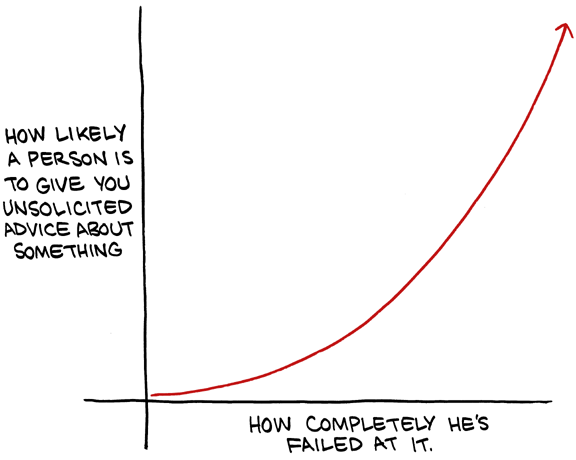
Unsolicited advice

Source


The worry is that my mother occasionally gives me unsolicited advice on how to raise kids.

Monday, August 29, 2011

Conception Day

Better mark this day in the calendar. I know just how the parent's feel... Happy!
Source

Monday, August 15, 2011

Sorry mum

The truth hurts. I just hope my sons keep this in mind when their mum asks for help fixing her 3D printer twenty years from now.

Source

Tuesday, August 9, 2011

The Finnish Education system

Great article at Salon, titled "How Finland became an education leader"

Some key quotes:
in the 1970s [Finland] completely transforming the preparation and selection of future teachers. That was a very important fundamental reform because it enabled them to have a much higher level of professionalism among teachers. Every teacher got a masters degree, and every teacher got the very same high quality level of preparation.

So what has happened since is that teaching has become the most highly esteemed profession. Not the highest paid, but the most highly esteemed. Only one out of every 10 people who apply to become teachers will ultimately make it to the classroom. The consequence has been that Finland's performance on international assessments, called PISA, have consistently outranked every other western country, and really there are only a handful of eastern countries that are educating with the same results.
[...]
There is no domestic testing except a very quiet auditing program to test demographic samples of kids; not for accountability, not for public consumption, and not for comparison across schools. The fascinating thing is that because they have created such a high level of professionalism, they can trust their teachers. Their motto is "Trust Through Professionalism." The difference between the highest performing school in Finland and the lowest performing school in Finland is less than four percent, and that's without any testing at all.
[...]
what's different in Finland is that there has been a bipartisan consensus over 30 years about the importance of education and the importance of high-quality teaching as the real solution. It's been a partnership between businesses, policy makers and educators, and that's what we need in [America] but don't have.
[...]

they've defined professionalism as working more collaboratively. They give their teachers time in the school day and in the school week to work with each other, to continuously improve their curriculum and their lessons. We have a 19th century level of professionalism here, or worse, it's medieval. A teacher works alone all day, everyday, and isolation is the enemy of improvement and innovation, which is something the Finns figured out a long time ago. Get the teachers out of their isolated circumstances and give them time to work together.

Monday, June 20, 2011

Create Your Own Choose-Your-Own-Adventures!

http://www.cyocyoa.com/index.php

How cool. I think I can use this, but I'm not sure for what just now.
The main thrust of the site is to allow the creation of interactive fiction similar to the Choose Your Own Adventure! series of books. However, with the tools you're given, you can also create quizzes, informational wiki-type entities, dating games, conceptual poetry, and all sorts of things I haven't even thought of.
The site will also be expanding steadily to allow more possibilities in adventure creation, so the possibilities

Wednesday, May 18, 2011

Infinite free energy

Source

Perfect! Er, except children are expensive... and they tend to fall asleep or grow up.

Thursday, April 28, 2011

Fascism and Divergent Thinking at Schools

Two links that seem unrelated are infact not.

First there is a great RSA Animate version of a talk on Changing Education Paradigms by Sir Ken Robinson


At about the 4 minute this he states a belief that ADHD is a "fictitious epidemic" and that children who are living in the most intensively stimulating period on earth are being regularly medicated and penalised for being distracted from boring stuff at school. They are being given drugs to get them focussed and settle down. We are getting them through school by anaesthetising them. We should be waking them up. And Sir Robinson notes that much of this drive for conformity is correlated with standardised testing and the way schools are modeled on the industrialisation and the production line mentality.

I could not agree more - and I speak as someone who could have probably benefited from these drugs at school - but just to help me fit in rather than to become a more creative student and be fully alive. It would have contained by ability to think divergently.

The second post is from http://www.ronjoneswriter.com/wave.html, which details a class 'exercise' from 1967 in Palo Alto, where a teacher named Ron Jones, tried to 'simulate what happened in Germany by having his students "basically follow instructions" for a day.'

The results were scary and worth reading. Towards the end, the author quotes Jones
"Fascism is always a possibility because it's so simple and people are frustrated. They lose their jobs, their dignity, their sense of worth, and someone comes along and says, "I've got the answer."

School systems prepare the ground, Jones says by using only standardized tests for success and failing to recognize alternative paths of learning, as well as a wider variety of individual achievements.

Educational institutions weed out troublemakers and those who are difficult to teach, he contends, rewarding placid students who want to succeed at any cost and will accept authority.

"That's the sad thing. Teachers can trigger it by telling students they're special, they're part of a community, that they can do special things. All they have to give is their loyalty," Jones concludes. "It happens every day in school, only the paraphernalia isn't there. Kids aren't learning to ask questions. You create a population where freedom's just a spelling word."
Can you see the connection now?

Monday, March 21, 2011

Growing up to be a superhero

The other night I was talking with my four year old son and we somehow got onto the topic of studying and working. So I asked him what he wanted to do for work. He thought about it for a while and said he wanted to be a "Protector", who looked after people.  I told him this was a great job.

He thought about it some more and changed his mind - he wanted to be a "superhero".

'Me too', I said, 'but its one of the rarest and hardest jobs there is'

So this one is for him

Source

Friday, March 18, 2011

Always wanted a mute button for my kids

Source
Now, if I could only find one for older kids.

Monday, January 17, 2011

Guns and toddlers don't mix

Talk about stupid. This guy hands his young son a loaded pistol with the safety off. And I get in trouble if I give my toddler a plastic knife to use while eating!

ShareThis